Who is God in Advaita Vedanta?
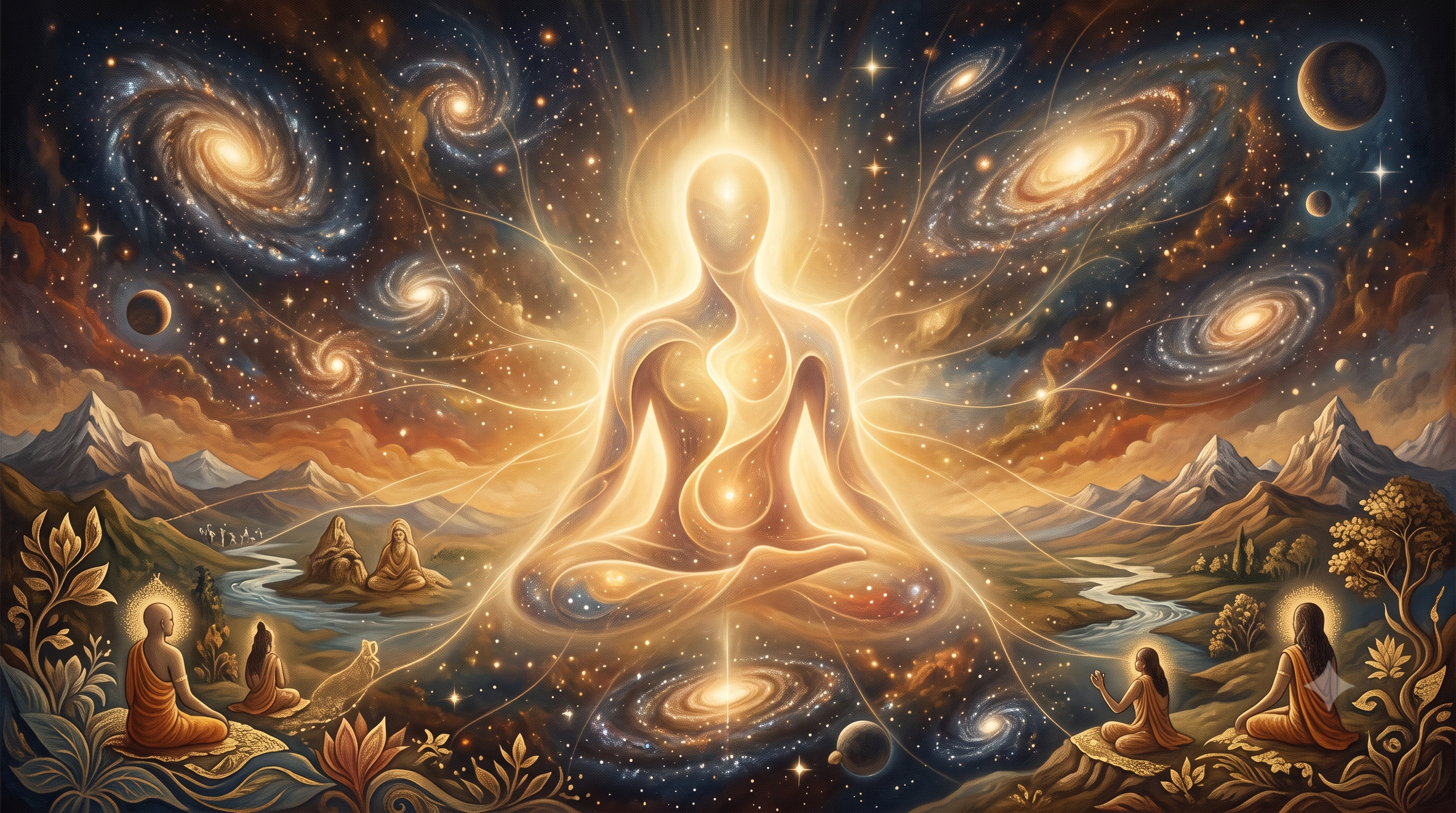
Who is God in Advaita Vedanta? A Journey into the Absolute and the Manifest
The question “Who is God?” has resonated through human consciousness across millennia, giving rise to myriad theological and philosophical systems. In the rich tapestry of Indian thought, Advaita Vedanta offers a unique and profoundly nuanced answer, one that transcends conventional notions of a personal deity while simultaneously embracing the divine as the very essence of existence. For the Advaitin, the concept of ‘God’ is understood through a dual lens: the ultimate, transcendent reality known as Brahman (ब्रह्मन्), and its manifest, immanent aspect, Ishvara (ईश्वर). This distinction is crucial for navigating the Advaitic path of Gyana Yoga (ज्ञानयोग), the yoga of knowledge, which seeks to unveil the non-dual truth.
The Bhagavad Gita, a foundational text for many schools of Hindu thought, provides an excellent starting point for understanding this intricate relationship. Lord Krishna, as the divine speaker, often identifies Himself with the ultimate reality, yet speaks in terms that are both personal and universal. Consider these profound verses from the seventh chapter:
एतद्योनीनि भूतानि सर्वाणीत्युपधारय। अहं कृत्स्नस्य जगतः प्रभवः प्रलयस्तथा॥ मत्तः परतरं नान्यत्किञ्चिदस्ति धनञ्जय। मयि सर्वमिदं प्रोतं सूत्रे मणिगणा इव॥ — Bhagavad Gita 7.6-7
Know this (Prakriti) to be the womb of all beings; I am the source of the outcoming of the whole universe, and likewise the source of its dissolution. There is nothing higher than Myself, O Arjun. Everything rests in Me, as gems strung on a thread.
These verses encapsulate the Advaitic understanding of Ishvara – the personal God – as the supreme Lord, the creator, sustainer, and dissolver of the cosmos. Yet, Advaita goes deeper, asserting that this Ishvara is ultimately a manifestation of the attributeless Brahman, perceived through the veil of Māyā (माया).
Brahman: The Ultimate, Attributeless Reality (निर्गुण ब्रह्म)
At the pinnacle of Advaita Vedanta’s philosophical edifice stands Brahman (ब्रह्मन्), the Absolute Reality. This is not a God in the conventional sense, but the supreme, all-pervading, infinite, and eternal principle that is beyond all attributes, distinctions, and limitations. It is Nirguna Brahman (निर्गुण ब्रह्म) – Brahman without qualities.
[!NOTE] 💡 Nirguna Brahman (निर्गुण ब्रह्म) The ultimate, transcendent reality in Advaita Vedanta, devoid of all attributes, forms, and distinctions. It is beyond space, time, causation, and all conceptual categories. It is ineffable, apprehended only through direct, non-dual experience (अनुभूति). The Upanishads describe it often through negation: “Neti, neti” (नेति नेति - not this, not this).
The Upanishads, the philosophical core of the Vedas, are replete with descriptions of this ineffable truth. The Brihadaranyaka Upanishad famously states:
अथात आदेशो नेति नेति। न ह्येतस्मादिति नेत्यन्यत्परमस्ति। — Brihadaranyaka Upanishad 2.3.6
Now, therefore, the description (of Brahman): ‘Not this, not this.’ For there is no other and more appropriate description than this ‘Not this.’
This “neti neti” approach underscores Brahman’s transcendence. It is not an object of perception, thought, or speech. It is the very subject, the substratum of all existence, the Self (Ātman) of all beings. The realization of “अहं ब्रह्मास्मि” (Aham Brahmāsmi - I am Brahman) and “तत्त्वमसि” (Tattvamasi - That thou art) signifies the non-dual identity of the individual Self with this ultimate reality.
Ishvara: The Personal God, Manifest through Māyā (सगुण ब्रह्म)
While Nirguna Brahman is the ultimate truth, the human mind, conditioned by its inherent limitations (upādhis - उपाधि), struggles to grasp an attributeless reality. It requires a form, a name, a set of qualities to comprehend and relate to the divine. This is where Ishvara (ईश्वर) comes into play.
[!NOTE] 💡 Ishvara (ईश्वर) The personal God in Advaita Vedanta, also known as Saguna Brahman (सगुण ब्रह्म) – Brahman with attributes. Ishvara is the omniscient, omnipotent, omnipresent creator, sustainer, and dissolver of the universe, perceived through the power of Māyā. Ishvara is the highest empirical reality, the object of devotion and worship, and the cosmic Self.
Ishvara is Brahman associated with Māyā (माया), the mysterious power that projects the universe and conceals the true nature of reality. Unlike the jīva (जीव - individual soul) who is deluded by Māyā, Ishvara is the controller of Māyā. He is the cosmic magician, wielding Māyā to manifest the diverse world of names and forms (nāma-rūpa - नामरूप). Adi Shankaracharya, the preeminent exponent of Advaita, explains that Ishvara is the nimitta-kārana (निमित्तकारण - efficient cause) and upādāna-kārana (उपादानकारण - material cause) of the universe, not in a literal sense as a separate entity, but through His inherent power of Māyā.
The Bhagavad Gita verses cited earlier perfectly describe Ishvara. When Krishna says, “I am the source of the outcoming of the whole universe, and likewise the source of its dissolution,” He speaks as Ishvara, the Saguna Brahman. He is the cosmic principle from which all beings emerge and into which they ultimately dissolve. This is the divine ground of all existence, the Lord of creation.
The Metaphor of Gems on a Thread: Unveiling the Unseen Substratum
The second part of Gita 7.7, “मत्तः परतरं नान्यत्किञ्चिदस्ति धनञ्जय। मयि सर्वमिदं प्रोतं सूत्रे मणिगणा इव॥” (There is nothing higher than Myself, O Arjun. Everything rests in Me, as gems strung on a thread), offers a profound metaphor for understanding Ishvara’s pervasive presence and relationship with the universe.
Imagine a garland of exquisite gems. Each gem is distinct in its shape, size, and color, representing the myriad forms and experiences of the phenomenal world – different beings, races, creeds, sentient and insentient objects. To the “naked eye” (the eye of sensory perception), only the gems are visible. The string that holds them together, though unseen, is indispensable. Without it, the gems would scatter, losing their coherence and form as a garland.
Similarly, the universe, with its bewildering diversity, appears as a collection of separate entities. The “naked eye” of the common person perceives only these outer forms, their nāma (name) and rūpa (form). It fails to discern the unifying, indwelling presence that binds them all. This unifying presence is Ishvara, the Lord, who acts as the substratum (adhishthāna - अधिष्ठान) and sustaining power behind the entire cosmos.
Shankaracharya, in his commentary on this verse, emphasizes that “मत्तः परतरम्” (nothing higher than Myself) refers to the Supreme Brahman, who is the Self of all. The universe, in its apparent multiplicity, is not separate from this ultimate reality. It is prota (प्रोत - strung, interwoven) in Brahman, just as gems are strung on a thread. The thread is not merely a binder; it is the essential, continuous element that gives structure and unity to the disparate gems.
This metaphor elegantly illustrates several key Advaitic principles:
- Immanence and Transcendence: Ishvara is both immanent (the string within all gems) and transcendent (the ultimate reality beyond the individual gems).
- Unity in Diversity: Despite the apparent differences, a single, unifying principle underlies all existence.
- Substratum (Adhishthana): Ishvara is the unchanging ground upon which the changing phenomena of the universe appear.
- The Unseen Reality: The ultimate truth is not immediately apparent to ordinary perception but requires a deeper insight.
To deny the existence of the string because it is not directly seen is akin to the ignorance of a blind man denying the sun. It is a failure of perception, not a refutation of reality. The presence of a rational, unifying principle behind the cosmos is self-evident to a discerning mind.
The Eye of Knowledge (ज्ञानचक्षुस्): Perceiving the Lord Everywhere
The ability to perceive this unseen string, this indwelling Lord, is not a matter of physical sight but of ज्ञानचक्षुस् (jñānacakṣus) – the eye of knowledge. This spiritual insight allows one to see beyond the superficial nāma-rūpa and apprehend the eternal, changeless reality that pervades all.
He who sees the sentient in the midst of the insentient, the eternal in the midst of the perishable, the changeless in the midst of the changing, is the wise man.
The upādhi (उपाधि - limiting adjunct), such as the physical body, is inherently insentient and perishable. Yet, pervading this and the entire universe is the Omniscient Lord. The journey of Gyana Yoga is precisely about cultivating this eye of knowledge. It involves:
- Śravaṇa (श्रवण): Hearing the truth from the scriptures and a qualified Guru.
- Manana (मनन): Reflecting deeply on these teachings, removing doubts through logical inquiry.
- Nididhyāsana (निदिध्यासन): Meditating continuously on the truth, internalizing it until it becomes a direct experience.
When the eye of knowledge is opened, often by the grace of the Lord (ईश्वरकृपा - Ishvarakṛpā) and diligent spiritual practice, one recognizes His presence everywhere. The world is no longer seen as a collection of disparate objects but as a manifestation of the one divine essence. One understands that Ishvara is the final cause of the universe, creating, sustaining, and dissolving everything through the power of His Māyā.
The Advaitic path culminates in the realization that the individual self (Jīva) is not distinct from the universal Self (Ātman), which is Brahman. The ignorant person identifies with the body; the partially wise person identifies with the jīva (the individual soul, still bound by ego and karma); but the true sage, the jñāni (ज्ञानी), sees the Ātman, recognizing its non-duality with Brahman. This is the ultimate perception of “God” in Advaita – not as an external entity, but as one’s own innermost Self, the very ground of being.
The Role of Māyā: The Cosmic Illusionist
No discussion of Advaitic understanding of God is complete without acknowledging Māyā (माया). Māyā is the inexplicable power of Brahman (specifically, of Ishvara) that makes the one appear as many, the real appear as unreal, and the attributeless appear with attributes. It is neither absolutely real (like Brahman) nor absolutely unreal (like a sky-flower). It is anirvacanīya (अनिर्वचनीय) – indefinable.
Ishvara is the Lord of Māyā, while the jīva is under its sway. It is Māyā that creates the illusion of a separate world and a separate God, allowing for devotion and worship. For the devotee, Ishvara is supremely real, the object of love and surrender. For the jñāni, Ishvara is the highest empirical reality, a stepping stone to the realization of Nirguna Brahman. The universe, as a product of Māyā, is considered mithyā (मिथ्या) – empirically real but ultimately illusory, like a dream or a mirage. It has a dependent reality, resting on Brahman.
Conclusion: The Non-Dual Vision
In Advaita Vedanta, the question “Who is God?” ultimately leads to the profound realization of non-duality. Ishvara, the personal God, is the magnificent manifestation of Brahman, accessible to the conditioned mind and the object of all religious devotion. He is the cosmic string holding the universe together, the source and end of all creation. Yet, for the Advaitin, this is not the final truth. The ultimate reality is Nirguna Brahman, the attributeless Absolute, which is identical with one’s own deepest Self (Ātman).
The journey from perceiving Ishvara as an external Lord to realizing Ātman as Brahman is the essence of Advaita. It is a journey from duality to non-duality, from the perceived world of names and forms to the underlying, eternal consciousness. The seeker is encouraged to take refuge in the thought that the Lord is in all, and that there is nothing other or higher than He, understanding that this “He” ultimately refers to the non-dual Brahman, the Self of all. This understanding liberates one from the cycles of birth and death, leading to mokṣa (मोक्ष) – ultimate liberation and the experience of infinite bliss.
Frequently Asked Questions (FAQ)
1. What is the primary difference between Brahman and Ishvara in Advaita Vedanta? In Advaita Vedanta, Brahman is the ultimate, transcendent, attributeless reality (Nirguna Brahman), beyond all concepts, forms, and qualities. Ishvara, on the other hand, is Brahman associated with Māyā (cosmic illusion), appearing as the personal God with attributes (Saguna Brahman). Ishvara is the omniscient, omnipotent creator, preserver, and destroyer of the universe, serving as the object of devotion, while Nirguna Brahman is the ultimate, ineffable truth to be realized as one’s own Self.
2. How does Advaita reconcile the concept of a personal God with an impersonal Absolute? Advaita reconciles them by positing that Ishvara (the personal God) is the highest empirical manifestation of Brahman, perceived through the lens of Māyā. For the conditioned mind, Ishvara is supremely real and serves as the focus of worship and devotion. However, from the ultimate, transcendental perspective (paramārthika), Ishvara is not ultimately distinct from Nirguna Brahman. The personal God is a provisional reality, a stepping stone on the path to realizing the impersonal, non-dual Absolute.
3. What is the significance of the “gems on a thread” metaphor in Advaita? The “gems on a thread” metaphor (Bhagavad Gita 7.7) illustrates that the diverse universe (gems) is unified and sustained by a single, unseen reality (the thread). This thread represents Ishvara (or ultimately Brahman), the indwelling presence that pervades and holds together all phenomena. It signifies that despite apparent multiplicity, there is an underlying unity, and that the ultimate reality is the unseen substratum, not merely the visible forms.
4. What is Māyā and its role in Advaita Vedanta? Māyā is the inexplicable, beginningless power of Brahman (or Ishvara) that projects the phenomenal universe and conceals the true nature of reality. It is neither absolutely real nor absolutely unreal, hence described as anirvacanīya (indefinable). Māyā is responsible for the appearance of duality and the illusion of a separate world and individual selves. Ishvara controls Māyā, while individual souls (jīvas) are deluded by it.
5. How does one perceive God according to Advaita Vedanta? According to Advaita, perceiving God is not through the physical senses but through the “eye of knowledge” (jñānacakṣus). This involves transcending the perception of names and forms (nāma-rūpa) and realizing the eternal, changeless reality that pervades all. This insight is cultivated through śravaṇa (hearing scriptures), manana (reflection), and nididhyāsana (meditation), leading to the direct, non-dual experience of Ātman as Brahman.
6. Is Advaita Vedanta atheistic or polytheistic? Advaita Vedanta is neither atheistic nor polytheistic in the conventional sense. It is monistic, asserting the ultimate reality of one non-dual Brahman. While it acknowledges various deities as manifestations of Ishvara (Saguna Brahman), these are seen as different forms of the one ultimate reality, suitable for different temperaments and stages of spiritual development. Ultimately, Advaita transcends all distinctions, including that of a separate God, by declaring the identity of the individual Self (Ātman) with the Absolute (Brahman).
Related Reading
संसार मिथ्या है - वेदान्त दृष्टि
वेदान्त की गहन दृष्टि से संसार की मिथ्याता को समझें। यह लेख बताता है कि कैसे इस दार्शनिक सत्य को दैनिक साधना में उतारकर साक्षी भाव प्राप्त करें और आंतरिक शांति का अनुभव करें।

मौन की यात्रा - जीवन सत्य और स्वतंत्रत
ौन के पवित्र आश्रय में सौंदर्य जीवंत हो उठता है। मौन के उस निर्मल सौंदर्य की वेदी पर विनम्रता जीवन के साथ सहजता से खेलती है। और जब विनम्रता में एक आंतरिक लय उत्पन्न होती है, तब उसके प्रकाश में निर्दोषिता स्वयं को प्रकट करने लगती है।

Finding the Universe Within - A Guide to Mindfulness, Letting Go, and True Joy
If the whole universe can be found in our own body and mind, this is where we need to make our inquiries. We all have the answers within ourselves—we just have not got in touch with them yet. The potential of finding the truth within requires faith in ourselves.